
Author: JIE GONG, JIN LI, LILIAN XU, AND LEILA ZHANG
Background: The Scalability Challenge
Yum China is the largest restaurant company in China, operating KFC, Pizza Hut, Taco Bell, Lavazza, and several local brands. In 2025, it reported record revenue of approximately US$12 billion across more than 18,000 restaurants. To sustain growth at this scale, the group pivoted to digital: today, serving a member base of over 590 million, more than 90% of orders are placed online through apps, mini-programs and third-party platforms.
However, this digital shift created a new bottleneck. Unlike in-store dining where issues are resolved face-to-face, digital friction—such as voucher errors or delivery delays—drives customers to the contact center. For over twenty years, this center operated as a classic “people business,” relying on large frontline teams, heavy supervision, and extensive support functions for recruiting and training.
As digital orders grew, demand became both high and highly volatile. Marketing campaigns like game IP tie-ins or “Crazy Thursday” triggered sharp traffic peaks within a single hour. Simultaneously, promotion cycles accelerated; instead of one campaign every few weeks, complex offers ran continuously across multiple platforms. This complexity exploded the knowledge base required of customer service representatives, and training simply could not keep pace.
In this environment, hiring humans to chase peaks and having them stand idle during the troughs was no longer viable. Any solution that still relied on linearly adding headcount would eventually hit a wall. This is where AI has a structural advantage: once a digital system is built and deployed, the supply of digital labor is “unlimited”. One more promotion wave, ten times more chats, an unexpected spike in calls – none of these require recruiting and training another cohort of human agents.
The Intervention: The C-Smart Digital Workforce
Yum China’s solution, initiated in 2018, was to pivot from a labor-heavy model to a digital labor workforce anchored by an AI agent called “C-Smart” (C睿). Evolving from simple keyword matching to advanced GenAI, C-Smart has advanced from a basic tool into a versatile “digital colleague” that assumes multiple roles within the contact center.
Front‑line digital agent. C-Smart functions primarily as a frontline agent, handling the bulk of inquiries independently. Analysis of historical data revealed that requests fall naturally into three categories: (A) information (about promotion activities, products or restaurants), (B) order services (checking status, urging, changing or cancelling orders), and (C) complex or emotionally charged issues such as faults and complaints.
This classification allows Yum China to standardize high-volume Type A and B contacts, which C-Smart resolves end-to-end across voice and online channels. Crucially, the system automatically detects judgment-heavy Type C cases and routes them to experienced human agents. Unlike human staff, this digital workforce connects instantly, operates continuously, and delivers consistent performance unaffected by turnover, fatigue, or mood.
Real-Time Co‑pilot. When human intervention is required, C-Smart acts as a real-time assistant. As the human agent communicates with a customer, the AI listens in, instantly surfacing relevant knowledge documents and suggesting replies. This support significantly reduces the time human agents spend searching for answers and ensures accuracy and consistency, even in complex situations.
Comprehensive Voice of Customer. Beyond operational support, C‑Smart serves as a comprehensive voice of the customer. Its “full analytics” module scans the transcript of every interaction, analyzes customer intent and emotional signals, and enables the company to evaluate 100% of cases rather than relying on small samples for quality checks. The value goes beyond QA: because the contact center is often the first line during major incidents, full‑volume analysis can quickly tag and cluster emerging issues and route structured summaries to brand teams. This helps decision makers rapidly understand what customers are saying—and triggers timely adjustments in messaging, policies, or operations.
The New Service Model
This transition represents a fundamental change in the contact center’s economic structure, shifting from a staffing-led model to a technology-driven one.
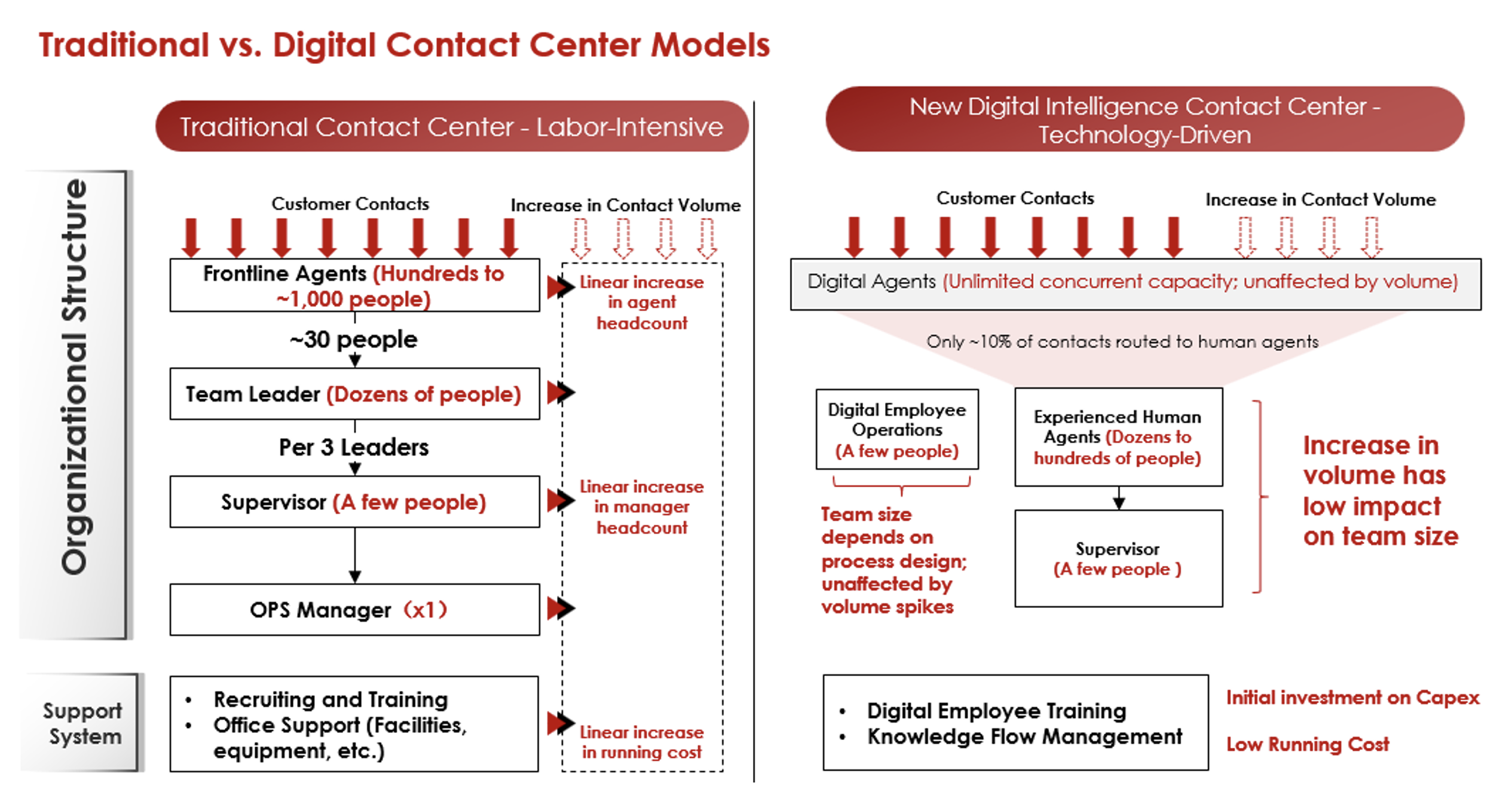
Traditional Model: The Linear Trap. In the traditional labor-intensive model, headcount is determined directly by expected contact volume. As orders and store visits grow, the number of frontline human agents must increase linearly. This creates a compounding hierarchy where every cohort of human agents requires team leaders and supervisors, causing labor costs and organizational complexity to rise in lockstep with demand.
Digital Model: Decoupling Volume from Headcount. In the new digital intelligence model, this link is broken. C-Smart absorbs the majority of incoming requests with effectively unlimited concurrent capacity. A small “digital employee operations” team maintains the system, routing only ~10% of contacts—the complex cases—to experienced human agents. Consequently, team size is driven by process design and business complexity rather than daily volume spikes, allowing running costs to grow much more slowly than traffic.
Results: Six Times the Volume, One-Third the People
The impact of this digital transformation is best visible in the divergence between business volume and team size. Between 2018 and 2025, customer contact volume increased six-fold to over 60 million contacts per year. Yet, the operation delivered higher service capacity with a much leaner staffing footprint. By 2025, digital employees were processing approximately 90% of all contacts.
Beyond efficiency, the model has reshaped how quality is managed. Yum China now evaluates human and digital agents’ performance on the same footing using the full analytics, revealing a clear trade-off. C-Smart leads on speed but can be prone to “mechanical” replies. Conversely, humans offer better empathy but struggle with slow response times and managing negative emotions. These insights drive a targeted strategy: the AI is tuned for better comprehension and natural language, while human agents are coached specifically on emotional skills. As the system optimizes along these lines, overall dissatisfaction has fallen and measured service quality continues to rise.
Ultimately, the center’s performance no longer depends on how quickly human agents can accumulate experience, but on how fast the digital employee can be updated. Once a new knowledge flow is taught to C-Smart, it can be deployed instantly across millions of interactions, making the organization far more agile than the traditional model allowed.
*All Nano Case materials may be used for non‑commercial purposes with proper citation. Commercial use requires prior permission from CAMO.
Table of Contents
Click to Jump ⬆️